
Hydraulic Cylinder Parts Explained
A practical guide to the main parts of a hydraulic cylinder — what each component does, how they work together, and which parts are most commonly linked to leaks, drift, scoring and early failure.
Use this page as a clear reference if you are learning hydraulic cylinder basics, identifying components, or trying to understand how faults develop in the real world.
Quick answer: what are the main parts of a hydraulic cylinder?
The main parts of a hydraulic cylinder are the barrel, piston, piston rod, gland / end cap, seals, wear rings, and mounting points. Together, these components convert hydraulic pressure into controlled linear movement.
On this page
Use this to jump straight to the component you want to understand.
1) Hydraulic cylinder diagram
This simplified cross-section gives you a visual overview of the internal layout of a hydraulic cylinder. Use it as a quick reference while reading the explanations below.
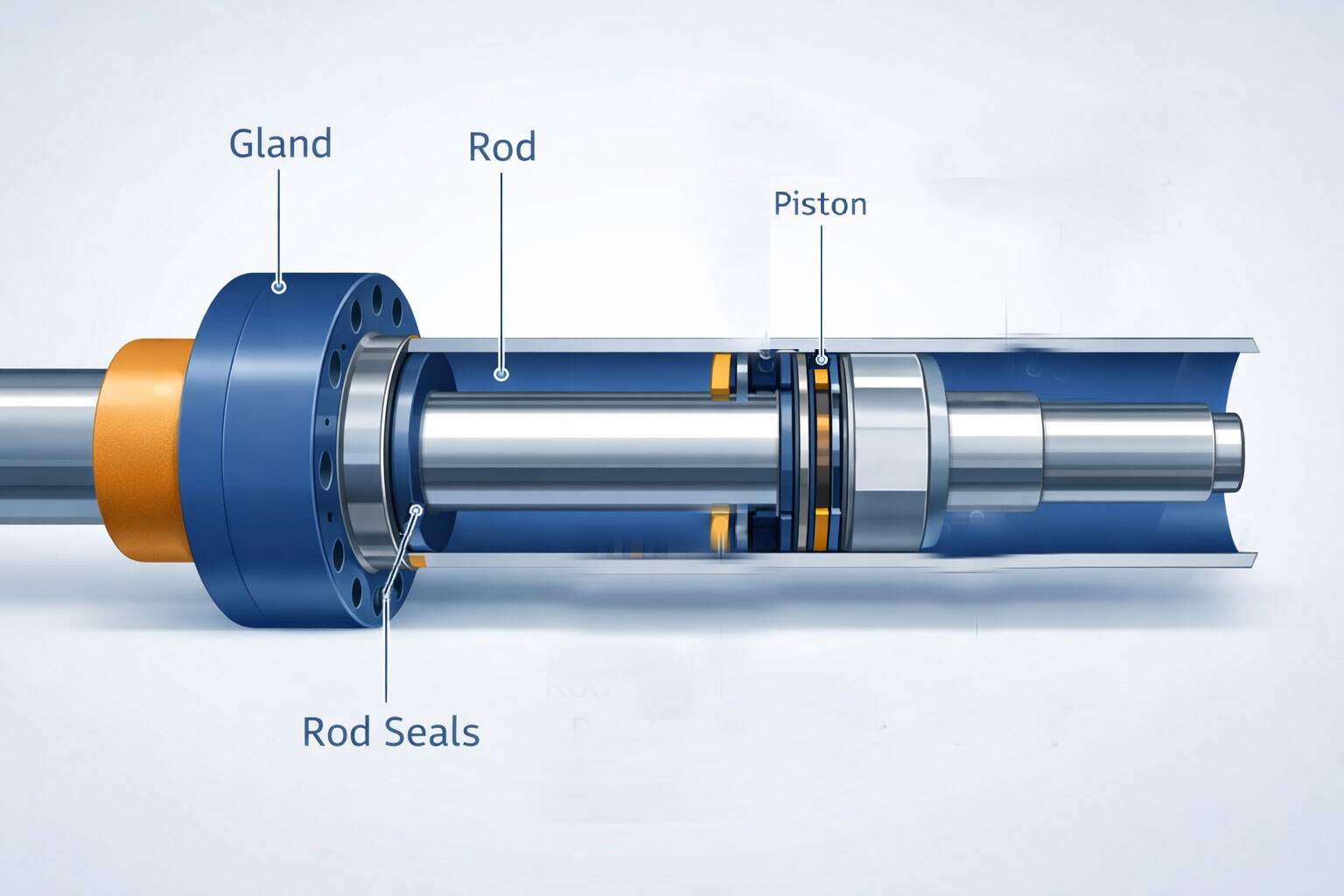
2) Main hydraulic cylinder parts at a glance
These are the core components you will find in most hydraulic cylinders, whether welded, tie-rod, or application-specific designs.
Barrel
The pressure vessel that contains the hydraulic fluid and provides the running surface for the piston seals.
Piston
The internal moving component that divides the cylinder into pressure chambers and creates force.
Piston rod
The shaft that transfers force out of the cylinder to do useful work on the machine or structure.
Seals & wipers
These keep oil in, contamination out, and maintain controlled movement under pressure.
Gland / end cap
Supports the rod, holds sealing elements, and closes the cylinder body at one end.
Mounting points
Eyes, clevises, trunnions or other fixings that connect the cylinder to the machine.
3) The barrel
The barrel is the main body of the cylinder. It contains the hydraulic pressure and provides the internal bore that the piston seals run against. The quality of the barrel bore has a major effect on sealing, friction, heat and service life.
What the barrel does
- Contains pressure safely
- Provides the sealing surface for the piston
- Helps control friction and internal bypass
- Supports the overall structural integrity of the cylinder
Common issues linked to the barrel
- Poor bore finish causing rapid seal wear
- Out-of-round geometry leading to drift or bypass
- Scoring caused by contamination
- Wear linked to poor materials or poor machining
4) The piston
The piston sits inside the barrel and divides the cylinder into two pressure chambers. When oil pressure acts on the piston, it drives movement and force through the rod. The piston also carries the piston seals and wear rings.
The piston depends heavily on good machining, correct groove dimensions, proper wear ring support, and a bore finish that matches the seal system. Poor control here is a major cause of internal bypass and heat build-up.
5) The piston rod
The piston rod transfers force out of the cylinder. It is one of the most exposed and vulnerable parts because it runs through the rod seals and is exposed to the working environment — mud, grit, washdown, salt spray, and impact.
Why rod condition matters
- Surface finish affects seal life
- Corrosion pits damage rod seals quickly
- Scoring creates leakage paths
- Misalignment can side-load the rod and increase wear
What often damages rods
- Wiper failure allowing grit to enter
- Incorrect rod protection for the environment
- Mechanical damage and impact
- Side-load or poor mounting geometry
6) Seals and wipers
Seals are what make the cylinder work properly under pressure. They stop oil leaking where it should not leak and help maintain controlled movement. Wipers sit at the rod entry point and stop dirt, grit and moisture from entering the cylinder.
Rod seals
Keep oil inside as the rod moves in and out of the gland.
Piston seals
Control bypass between pressure chambers inside the barrel.
Wipers
Protect the internal sealing system by scraping contamination from the rod.
7) The gland / end cap
The gland supports the rod and houses the rod sealing system. It is a critical component because it controls guidance and sealing at the point where the rod exits the cylinder body.
End caps close the cylinder and help define the internal pressure areas. Depending on design, the gland and end cap can be separate or integrated.
8) Mounting points
Hydraulic cylinders do not work in isolation. The mounting arrangement determines how the cylinder is loaded in service and whether side-load develops. A strong cylinder can still fail early if the mounting setup forces it into misalignment.
Eye mounts
Common and versatile, but alignment still matters.
Clevis mounts
Useful where pivoting movement is required.
Trunnion / fixed mounts
Need careful design to avoid introducing harmful side-load.
9) How the parts work together
A hydraulic cylinder works properly only when the parts work as a system. The barrel must be correct, the piston stable, the rod well-guided, the seals properly matched, and the mounting aligned. Most failures come from a problem in that system, not from one isolated part.
When the system is healthy
- Smooth controlled stroke
- Minimal leakage
- Stable holding under load
- Good seal life
When the system is unhealthy
- Drift or creep
- Rod scoring
- Heat build-up
- Repeat seal failures
Need help identifying a cylinder part or understanding a failure?
If you are looking at a damaged rod, worn seals, a scored barrel or a drifting cylinder, describe the issue and we can point you to the most relevant guidance.
- Clear, practical engineering guidance
- Built around real cylinder manufacturing and repair thinking
- Cylinder builds are performed in the Essex depot and shipped anywhere in the UK
Hydraulic cylinder parts FAQs
Short answers designed to work well for search and AI-generated summaries.
What are the main parts of a hydraulic cylinder?
The main parts are the barrel, piston, piston rod, gland or end cap, seals, wipers, wear rings, and mounting points. Each part affects how the cylinder handles pressure, movement and contamination.
What does the piston do in a hydraulic cylinder?
The piston divides the cylinder into pressure chambers and converts hydraulic pressure into linear movement. It also carries the piston seals and wear rings.
What causes rod seal failure?
Rod seal failure is often caused by poor rod finish, corrosion, scoring, contamination entering past a damaged wiper, or alignment issues that side-load the rod.
Why is the barrel bore so important?
The barrel bore provides the running surface for the piston seals. Its finish and geometry strongly affect friction, heat, bypass and seal life.
Can mounting type affect cylinder life?
Yes. Poor mounting and misalignment can create side-load, which increases friction, damages guidance surfaces and shortens seal and rod life.