
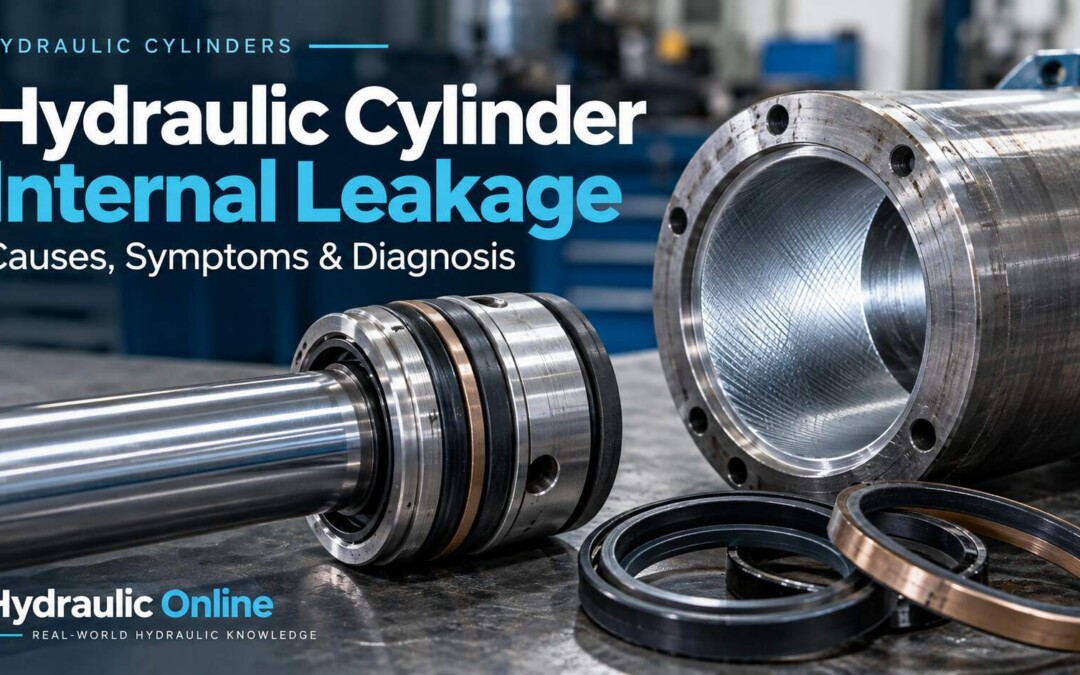
Hydraulic Cylinder Internal Leakage Explained
Learn what internal hydraulic cylinder leakage is, the symptoms it can cause,
why piston seals and barrel condition matter, and how to distinguish a cylinder
problem from faults elsewhere in the hydraulic system.
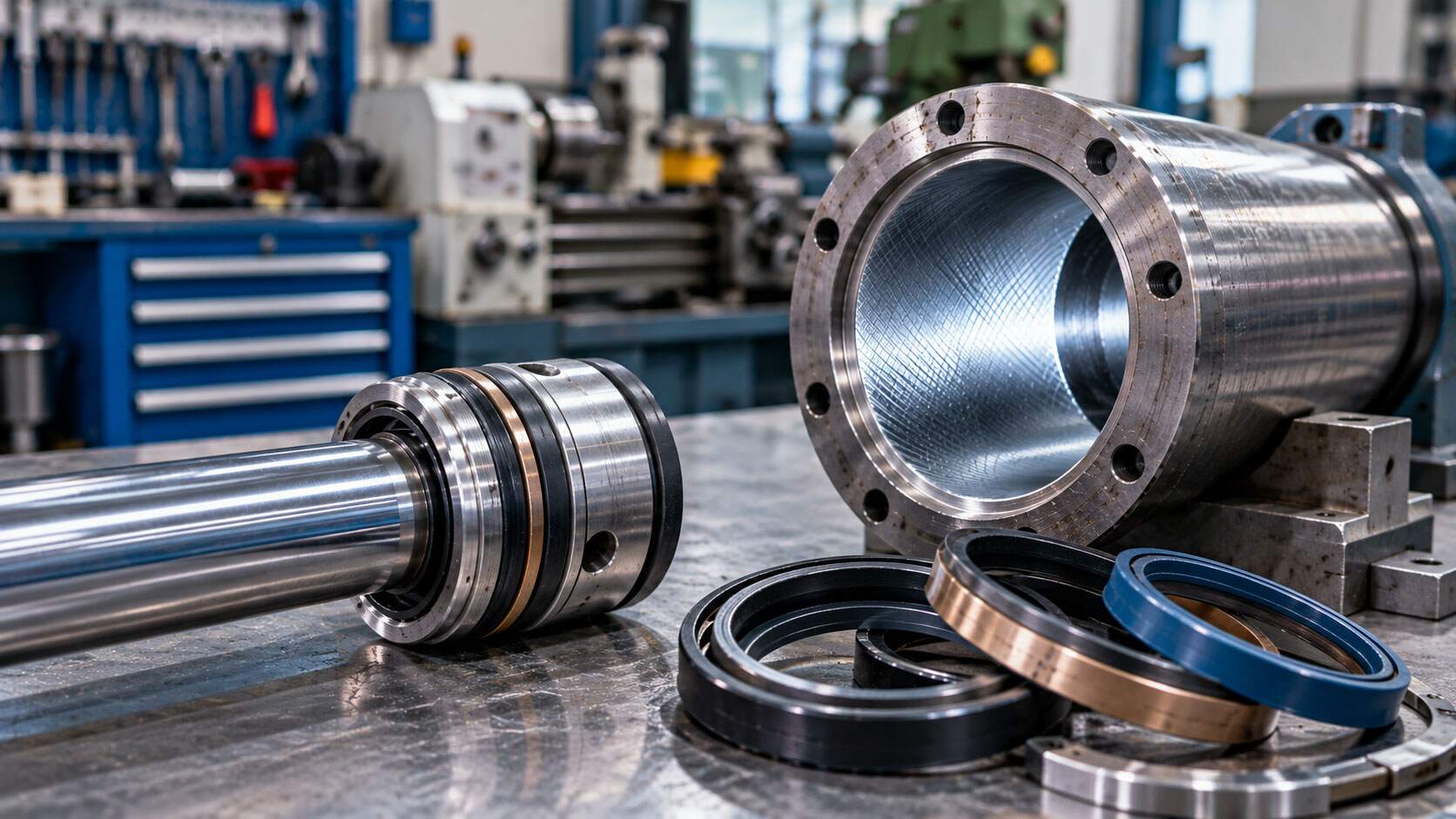
Internal leakage can occur without any hydraulic oil appearing outside the cylinder.
What is internal leakage in a hydraulic cylinder?
Hydraulic cylinder internal leakage occurs when hydraulic oil
passes internally from one side of the piston to the other when it should be
separated by the piston sealing system.
Depending on the hydraulic circuit and operating conditions, excessive internal
leakage can contribute to poor load holding, reduced force, unwanted movement,
heat generation or inefficient cylinder operation.
In one sentence: internal leakage is unwanted oil bypass inside
the cylinder rather than oil escaping externally from the cylinder.
Internal leakage vs external leakage
Both involve unwanted hydraulic oil movement, but they occur in very different places.
External Hydraulic Leakage
Hydraulic oil escapes from the cylinder to the outside environment.
Typical areas include the rod seal, ports, fittings, welds or damaged cylinder components.
External leakage is often visible as oil around the cylinder or surrounding machinery.
Internal Hydraulic Leakage
Oil bypasses internally, commonly across the piston sealing system,
while remaining inside the hydraulic circuit.
A cylinder can therefore develop a significant performance problem without an obvious external oil leak.
Important Diagnostic Point
A cylinder that will not hold position does not automatically have a leaking piston seal.
Control valves, load-holding valves and other parts of the hydraulic circuit can also allow unwanted movement.
Symptoms associated with internal cylinder leakage
The exact symptoms depend on cylinder design, load, circuit configuration and the severity
of the leakage. These signs can indicate that further investigation is required.
Reduced Force
Oil bypassing the piston can reduce the effective pressure difference available to move or hold the load.
Load-Holding Problems
The actuator may struggle to maintain the required position when subjected to an external load.
Unexpected Movement
Movement when the system should be stationary may indicate leakage somewhere in the cylinder or control circuit.
Slow Operation
Excessive bypass can reduce the amount of useful hydraulic flow contributing to cylinder movement.
Heat Generation
Hydraulic energy lost through unwanted leakage can contribute to inefficient operation and additional heat.
Repeat Seal Problems
New piston seals may fail again if bore damage, contamination, incorrect clearances or guidance problems remain unresolved.
What causes internal leakage in a hydraulic cylinder?
Excessive internal bypass is often associated with the piston sealing system,
but the underlying reason for seal failure can lie elsewhere in the cylinder.
1. Worn Piston Seals
Wear, ageing, heat, contamination or long service periods can reduce the piston seal’s ability to control oil bypass.
2. Damaged Seals
Cutting, extrusion, incorrect installation or unsuitable operating conditions can damage the sealing edge.
3. Scored Cylinder Bore
Scratches or scoring can create leakage paths and damage the piston seal as it travels through the barrel.
4. Bore Wear
Wear, distortion or poor bore geometry can prevent the piston sealing system from maintaining consistent contact.
5. Contamination
Hard particles can damage both seals and precision surfaces, creating progressive wear and leakage.
6. Guidance or Alignment Problems
Side-loading and inadequate guidance can create uneven wear on the piston, wear rings, seals and barrel surface.
Why piston seals matter
In a double-acting hydraulic cylinder, the piston separates pressure zones inside
the barrel. The piston sealing system controls unwanted oil transfer between those areas.
When the sealing system is damaged or no longer matches the condition of the bore,
excessive oil bypass can occur.
However, replacing the piston seal without investigating why it failed
can result in the same problem returning.
Areas Worth Inspecting
- Piston seal condition
- Wear rings and bearing surfaces
- Cylinder barrel scoring
- Bore geometry and wear
- Honed bore surface condition
- Contamination damage
- Piston condition and fit
- Evidence of side-loading
Think Beyond the Seal Kit
Repeat piston-seal failure should prompt inspection of bore condition, wear rings,
component clearances, contamination and cylinder alignment.
How bore wear and scoring contribute to leakage
The piston seal can only perform correctly when the surface it runs against is suitable for the sealing system.
Scoring
Longitudinal scratches can damage seals and potentially create paths through which oil can bypass the piston.
Surface Condition
The bore needs a controlled finish capable of supporting lubrication while providing an appropriate seal-running surface.
Geometry
Excessive wear, distortion or poor geometry can affect sealing contact and guidance of the piston assembly.
Does internal leakage cause hydraulic cylinder drift?
Excessive internal leakage can contribute to unwanted cylinder movement in some hydraulic systems,
but observing movement alone does not prove that the piston seals are leaking.
The behaviour of a loaded cylinder depends on the complete hydraulic circuit.
Leakage through directional control valves, counterbalance valves, load-holding valves or
other components may also influence whether the actuator maintains its position.
Do Not Diagnose Drift From One Symptom
If a cylinder moves when it should remain stationary, investigate both the actuator
and the hydraulic control circuit. Replacing piston seals without confirming
the source of the unwanted oil movement may not solve the problem.
Internal leakage diagnostic guide
Symptoms can help narrow the investigation, but they should be considered alongside
the machine, hydraulic circuit and cylinder condition.
| Symptom | Possible Cylinder Cause | Other Areas to Investigate |
|---|---|---|
| Cylinder will not hold load | Piston seal bypass, damaged bore or excessive internal wear | Control valve, load-holding valve and circuit leakage |
| Reduced cylinder force | Excessive piston bypass or internal damage | System pressure, pump performance, relief settings and load |
| Slow cylinder movement | Internal bypass or excessive friction | Available flow, restrictions, valves and pump condition |
| Repeated piston seal failure | Bore damage, poor guidance, contamination or unsuitable sealing | Operating temperature, fluid condition and machine alignment |
| Unexpected cylinder movement | Possible internal leakage | Directional valve and wider control circuit |
How is internal cylinder leakage diagnosed?
Proper diagnosis aims to determine whether unwanted oil movement is occurring inside
the cylinder or somewhere else in the hydraulic circuit.
The appropriate diagnostic procedure depends on the cylinder design, machine,
hydraulic circuit and safe isolation methods available for that equipment.
Inspection during strip-down can reveal evidence such as damaged piston seals,
scored bores, worn wear rings, contamination or abnormal component wear.
A Good Investigation Considers
- The exact symptom and when it occurs
- Whether the problem changes under load
- System pressure and available flow
- Valve and circuit leakage paths
- Cylinder piston sealing condition
- Barrel bore condition
- Wear rings and guidance components
- Previous repair history
Can internal hydraulic cylinder leakage be repaired?
In many cases, yes — but the correct repair depends on what is actually causing the leakage.
Resealing
If the components remain serviceable and the problem is limited to worn sealing elements,
replacement seals may restore performance.
Machining or Honing
Surface damage or dimensional issues may require corrective machining or bore finishing before new seals are installed.
Component Replacement
Significant barrel, piston, rod or guidance damage may require component replacement or a more extensive cylinder rebuild.
How to reduce the risk of internal leakage
1. Control Contamination
Clean hydraulic fluid helps protect precision surfaces, seals and guidance components from abrasive damage.
2. Correct the Root Cause
Do not repeatedly replace seals if scoring, misalignment, excessive wear or other underlying problems remain.
3. Inspect Cylinder Condition
Monitoring rods, seals, fluid condition and cylinder behaviour can reveal developing problems before severe damage occurs.
Related hydraulic cylinder guides
Hydraulic Cylinder Troubleshooting Guide
Diagnose leakage, slow movement, scoring and pressure loss.
Hydraulic Cylinder Failure Modes
Explore seal failure, rod damage, barrel wear and contamination.
Hydraulic Cylinder Honing
Understand bore finish, cross-hatch and seal performance.
Tolerances & Machining Standards
Learn why geometry, clearances and surface condition matter.
Why Hydraulic Cylinders Fail
Understand the underlying causes of premature cylinder failure.
Hydraulic Cylinder Parts
Explore the barrel, piston, rod, gland, seals and other components.
Need a hydraulic cylinder inspected or repaired?
Hydraulic Online explains how hydraulic cylinders work and why they fail.
Completely Hydraulic provides practical workshop support for hydraulic cylinder
repair, refurbishment and manufacture.
Hydraulic cylinder internal leakage FAQs
What is internal leakage in a hydraulic cylinder?
Internal leakage is unwanted hydraulic oil movement inside the cylinder,
commonly involving oil bypass across the piston sealing system rather than oil escaping externally.
What are the symptoms of internal leakage?
Possible symptoms include poor load holding, reduced force, slow operation,
unwanted movement, additional heat or repeated piston-seal problems.
Can worn piston seals cause internal leakage?
Yes. Worn or damaged piston seals can allow excessive oil bypass, although bore wear,
scoring, contamination and guidance problems may be responsible for damaging the seals.
Does cylinder drift always mean the piston seals are leaking?
No. Internal piston leakage is one possible cause of unwanted movement,
but leakage through control valves or other parts of the hydraulic circuit may also contribute.
Can a cylinder leak internally without leaking externally?
Yes. Internal leakage occurs inside the hydraulic system, so internal bypass can occur
without visible oil appearing outside the actuator.
Can internal hydraulic cylinder leakage be repaired?
Often it can. Repair may involve resealing, honing or machining, correcting guidance
problems or replacing damaged components depending on the cause and cylinder condition.
Understand the fault before replacing the parts
Internal leakage is a symptom of hydraulic behaviour. Finding the real cause —
whether it is piston sealing, bore condition, component wear or the wider hydraulic circuit —
is the key to a reliable repair.